The Warning Signs Guide
Structural vs. cosmetic, why “fixed” stairs still squeak, and the code numbers inspectors check — including the 4-inch sphere rule. Sent straight to your inbox.
One email with the guide. No spam, unsubscribe anytime.
Atlanta Stair Pricing Guide
How Much Does Stair Remodeling Cost in Atlanta, GA? (2026)
Last updated: July 18, 2026
Most Atlanta-area stair remodels run $2,900–$4,800. That is our published typical baseline for a straight staircase getting new oak treads and painted white risers — the most common scope we quote. It is not a fixed menu price, and it assumes a specific scope: a straight run (no curves or spirals), oak treads throughout, and risers that are painted white rather than stained or replaced with matching wood. Change the shape or the scope and the number changes with it. Curved or spiral staircases cost more to engineer and build than a straight run. Any work beyond the tread-and-riser baseline — new newel posts, a full handrail replacement, or swapped-out balusters — is priced as its own line item on top of the baseline, never bundled into it. Straightforward repairs (a squeak fix, a loose tread, respacing balusters for code) typically cost less than a full remodel, running $884–$2,549 based on Atlanta-market data. Because shape and scope vary this much project to project, every proposal we write is itemized for the actual stairs after we have seen them.
What the $2,900–$4,800 baseline actually includes
This figure is scope-specific, not a generic “stairs cost” number. It assumes:
- A straight staircase. Curved and spiral stairs require custom stringer fabrication and structural engineering that a straight run does not, and they cost more.
- New oak treads. Upgrading to a different species (white oak, engineered hardwood) changes material cost.
- Painted white risers only. Stained or wood-matched risers, or risers left open, are a different scope.
Anything beyond that — new newel posts, a full handrail replacement, or a baluster swap — is priced as a separate line item added on top of the baseline. We never bundle those changes into the headline number, because doing so would make the number meaningless for any staircase that isn’t exactly this scope.
Quick Reference
Atlanta stair costs by project type
Every row below is sourced — see the methodology note at the bottom of this page for where each figure comes from.
| Project type | Typical range | Notes |
|---|---|---|
| Repair (squeak fix, loose tread, code respacing) | $884–$2,549 | Atlanta average $1,696; most repairs bill $60–$250 per step |
| Refinish only (sand and refinish existing treads) | $321–$1,255 | National figures, average $788; no Atlanta-specific refinish data is separately published |
| Carpet-to-hardwood conversion (12-step run, red oak) | $1,250–$3,300 | Materials $600–$1,500, labor $650–$1,800 |
| Straight remodel — baseline (new oak treads, painted white risers) | $2,900–$4,800 | Our published Atlanta baseline; straight stairs only |
| Remodel + baluster replacement | Baseline + line item | Billed at $50–$150/hr carpentry plus material, itemized separately |
| Remodel + newel post & handrail replacement | Baseline + line item | Billed at $50–$150/hr carpentry plus material, itemized separately |
| Curved / spiral structural remodel | $3,900–$12,800 | Custom stringer fabrication and engineering cost more than a straight run |
| Full custom / engineered floating staircase | North of $100,000 | Structural engineering, steel fabrication, and code sign-off for a fully floating design |
All figures above are typical market ranges, not fixed prices. Your actual number depends on the condition of your existing stairs, the materials you choose, and whether the project triggers a code review. We write every proposal itemized for the specific stairs after a walkthrough.
Get an itemized number for your stairs
Get a Fixed-Price ConsultationWhat Moves The Price
Twelve things that change your stair remodel cost
Each of these is priced on its own merits — here’s what drives the number up or down for each one.
1. Tread material — oak vs. other species
Standard oak treads are what’s included in the $2,900–$4,800 baseline. Moving to a different species — white oak, a darker exotic hardwood, or engineered hardwood — changes the material cost, since those are priced by board foot once the species and grade are chosen. On a carpet-to-hardwood conversion, material alone for a standard 12-step run in red oak typically runs $600–$1,500; upgrading the species shifts that number up.
We spec tread material as part of the written proposal so you see the exact species and cost before anything is ordered, not after.
2. Riser treatment — painted white vs. stained or matched wood
Painted white risers are the baseline scope. Stained risers that match the tread wood, or risers left open (no riser board at all, for a lighter look), are both different scopes with different labor and material costs — matching stain to a new tread species takes more finish work than a coat of paint, and an open-riser conversion is a structural change, not a finish change.
3. Baluster material and style — matte black metal vs. wood
Matte black powder-coated metal is the material we’re seeing requested most in 2026 — it pairs a modern, slightly industrial look with a warm wood handrail, which is the combination trend research points to as the current favorite locally and nationally. Traditional wood spindles remain a solid, lower-maintenance option for homes matching an existing wood staircase.
Balusters are never bundled into the remodel baseline. Whichever material you choose, that work is billed at the same $50–$150 per hour carpentry rate as the rest of the project, plus material cost that varies by profile and finish, and it appears as its own line item on the proposal.
4. Newel post replacement
The newel post — the heavier post anchoring the bottom (and sometimes top) of the railing — is structural, not decorative, and replacing it is carpentry and installation labor plus the cost of the post itself. Because newel posts vary widely in material and size (a simple painted post vs. a heavy turned hardwood post), this is always quoted after we’ve seen the existing one and confirmed how it anchors into the framing.
5. Handrail replacement and type
A full handrail replacement is billed on the same $50–$150 per hour carpentry rate plus material, and the material choice matters: a straight wood rail, a rail paired with cable or metal balusters, or a rail with integrated LED lighting (a 2026 trend for statement entries) all carry different material and fabrication costs. Handrail height and graspability also have to meet current code, which we confirm as part of the same line item rather than as a separate surprise later.
6. Straight vs. curved or spiral structural complexity
A straight staircase uses standard stringer geometry, which is why it’s the scope our published baseline assumes. A curved or spiral staircase requires custom-fabricated stringers, often engineered and built off-site to exact measurements, plus more layout and structural work on install. Custom builds with hardwood treads, balusters, and railing together commonly run $3,900–$12,800, and complexity, not square footage, is the main driver of that gap.
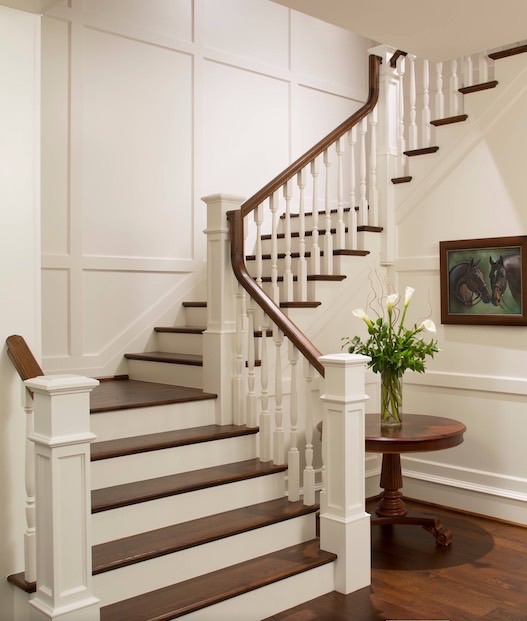
7. Carpet-to-hardwood conversion
Converting a standard 12-step carpeted staircase to hardwood — removing carpet and padding, prepping the substrate, and installing new treads — typically runs $1,250–$3,300 in red oak, split roughly between $600–$1,500 in materials and $650–$1,800 in labor. This is often the point where a previously hidden problem (uneven stringers, worn subsurface) surfaces, which is why we check every stringer before quoting the final number rather than pricing off the carpet alone.
8. Refinishing vs. full replacement
If your existing treads are structurally sound and just worn or dated, refinishing — sanding down and applying a new finish — is the lower-cost path at $321–$1,255 nationally, averaging around $788. Full replacement makes sense once treads are damaged, the wrong species, or you’re changing the look substantially (species change, riser change, open-riser conversion). We tell you honestly which category your stairs fall into rather than defaulting to the bigger job.
9. Code-compliance and permit-triggered work
Stairs are a life-safety egress path, so replacing or substantially altering one typically requires a permit and has to meet current baluster-spacing and rise-and-run code. This becomes a real cost driver most often when a different project — a kitchen remodel, a basement finish — happens to touch the stairs and triggers a code review the homeowner didn’t plan for. One documented case added roughly $4,000 to a project that was originally supposed to be purely cosmetic on the stairs. We flag whether your project is likely to trigger a permit at the consultation, before you sign anything.
10. Labor rates
Atlanta-area stair carpentry runs $50–$150 per hour depending on the complexity of the work and the carpenter’s specialization. Discrete repair work — fixing a specific step, respacing a section of balusters — is more commonly billed per step, at $60–$250 per step. Labor is the largest single driver behind why two seemingly similar jobs (a straight remodel vs. one with structural repair underneath) can land at different points in the same range.
11. Structural repair — stringers and squeak fixes
Squeaks almost always trace back to stringers that aren’t perfectly even, or treads bearing on only part of a stringer instead of the full width. Structural repair — shimming and blocking stringers, re-securing treads so they bear evenly, tightening loose fasteners — runs $884–$2,549 in the Atlanta market, averaging $1,696. This is priced separately from a remodel because the underlying frame, not the visible tread, is what’s being fixed.
12. Custom and floating stair engineering
A fully engineered floating staircase — treads that appear to hang unsupported off a hidden steel mono-stringer, with no visible risers or traditional stringers — requires structural engineering sign-off, custom steel fabrication, and precise on-site installation. That level of custom engineering commonly runs north of $100,000 for a fully realized design. It’s the far end of the range from a straight remodel, and it’s priced individually with an engineer involved from the design phase, not off a published range.
Local Factors
What makes stair costs higher in some Atlanta-metro areas
Housing stock age is the biggest local driver we see. Older homes are more likely to have original, worn, or code-outdated stairs that need structural work, not just a cosmetic refresh — and larger, higher-value homes more often call for longer runs, custom millwork, or statement-entry treatments that add to scope.
Decatur has the oldest average housing stock in the metro we track — homes built 1980 on average, with nearly half the housing stock built before 1970. That means the highest concentration of stairs genuinely needing structural attention, not just a cosmetic update.
Sandy Springs and Roswell both carry a large stock of 1980s–1990s homes with original builder-grade staircases — Sandy Springs has a median construction year around 1989, and Roswell’s homes skew similarly. These are common candidates for a carpet-to-hardwood conversion or a full remodel of stairs that have never been touched since the house was built.
Alpharetta has the highest median home values of the north-metro cities, with an average single-family home age around 30 years — remodels here skew more toward style upgrades (matte black balusters, statement rails) than structural necessity, but higher home values also mean more requests for higher-end material upgrades that add cost above the baseline.
Buckhead spans the widest range of any area we serve — from historic Georgian and Tudor estates to new contemporary builds — and represents the highest ceiling for premium, statement-entry staircase projects (cable railing, integrated LED lighting, custom newel posts).
Marietta has the broadest mix of home ages and the most accessible price point of the group, which tends to mean a wider spread of project types, from basic repairs to full remodels.
The same pattern holds across the wider metro. Older, established suburbs with 1970s–1990s housing stock — where a staircase has often never been touched since the original build — tend to need more structural work than newer construction. Larger or higher-value homes, wherever they are, tend to request more material and design upgrades on top of the baseline. We serve stairs across the following Atlanta-metro areas:
- Decatur
- Sandy Springs
- Roswell
- Alpharetta
- Marietta
- Buckhead
- Dunwoody
- Brookhaven
- Vinings
- Johns Creek
- Suwanee
- Peachtree Corners
- East Cobb
- Chamblee
- Tucker
- Smyrna
- Kennesaw
- Woodstock
- Milton
These are areas we serve, not a list of completed projects. Every stair job is priced individually regardless of neighborhood — area is a directional signal on housing stock, not a pricing factor by itself.
Which Path Fits
Refinish vs. repair vs. full remodel
These aren’t tiers of the same job — they solve different problems. Here’s how to tell which one you actually need.
| Approach | Typical cost | Best fit when… |
|---|---|---|
| Refinish | $321–$1,255 | Treads are structurally sound, just worn, dull, or the wrong finish color — no squeaks, no loose treads, no code issue |
| Repair | $884–$2,549 | A specific, isolated problem — a squeak, a loose tread, out-of-code baluster spacing — on stairs that are otherwise sound and don’t need a new look |
| Full remodel | $2,900–$4,800+ | Treads are damaged, dated, or the wrong material (carpet you want gone); multiple issues stack up; or you want a genuinely different look, not just a cleaned-up version of the current one |
If you’re not sure which category your stairs fall into, that’s exactly what the consultation is for — we tell you honestly which one applies rather than defaulting to the larger job.
ROI & Budgeting
What a stair remodel is actually worth — and how to budget for it honestly
An honest ROI answer
Unlike kitchens and bathrooms, staircases aren’t tracked as their own line item in the standard annual Cost vs. Value renovation reports the way those two rooms are — there’s no published “you’ll recoup X% of a stair remodel at resale” figure to point to, and we’re not going to invent one just to give you a number that sounds good.
What a solid, code-compliant staircase actually buys you is less abstract than a resale percentage: it removes a documented liability risk (a fall on a staircase is a real, recurring cause of home injury claims), it removes the specific risk of failing an inspection during a sale, and it removes the “first thing a buyer notices” problem — a worn, squeaky, original-builder staircase in an otherwise updated home reads as neglect to a walk-through buyer even when nothing else is wrong. Framed that way, the return is safety and liability avoidance plus buyer perception, not a resale-percentage line item nobody actually tracks for this trade.
Budgeting for the surprises, not just the baseline
The single biggest fear we hear isn’t the price itself — it’s the price changing after work has already started. Our answer is a written, fixed-price proposal, not a verbal ballpark. But even with a fixed price, we recommend budgeting an extra 20 percent on top of your target number as a contingency, specifically for permit and code surprises that only become visible once a wall or stringer is opened up.
Be cautious of a bid that comes in dramatically below every other estimate you’ve collected for comparable scope. The most common way a cheap bid stays cheap is by leaving out permit costs, using a lower repair standard on stringers you won’t see once treads go back down, or padding the number later with change orders once the job has already started and you’re less likely to walk away. Ask any contractor, including us, to itemize exactly what’s included before you compare price alone.
Get honest answers about your stair project
Get a Fixed-Price ConsultationCost Questions, Answered
More questions about stair remodel pricing
What’s the cheapest way to update an old staircase?
If your existing treads are structurally sound — no squeaks, no loose treads, no failed baluster spacing — refinishing is almost always the lowest-cost path, running $321–$1,255 nationally with an average around $788. That’s sanding down the existing wood and applying a new stain or finish rather than replacing anything. It only works if the structure underneath is genuinely sound, which is why we check stringers and tread security before recommending refinish over replacement; a refinish over a hidden structural problem just delays a bigger repair later and doesn’t actually save money.
How much does it cost to convert carpet stairs to hardwood?
A standard 12-step carpeted staircase converted to red oak hardwood typically runs $1,250–$3,300, split roughly between $600–$1,500 in materials and $650–$1,800 in labor. The range depends on tread condition once carpet comes off, whether risers are painted or matched to the wood, and whether the stringers underneath need shimming — something we usually can’t fully assess until the carpet is removed, which is why the final number is confirmed once we’ve seen what’s actually underneath, not estimated sight-unseen.
What does it cost to add matte black metal balusters?
Matte black powder-coated metal balusters are the material we’re seeing requested most in 2026, typically paired with a warm wood handrail for a modern-but-not-cold look. That work is never bundled into a remodel baseline — it’s billed at the same $50–$150 per hour carpentry rate as the rest of the project, plus material cost that varies by baluster profile, spacing, and finish. Because pricing depends on the exact style and the linear footage of railing involved, we quote balusters as an itemized line item after seeing your specific staircase, not as a flat per-baluster number.
What is a floating staircase, and how much does it cost?
A floating staircase uses treads that appear to hang unsupported in the air, typically anchored to a hidden steel mono-stringer along one side or the wall, with open risers and often minimal or cable railing. It requires structural engineering sign-off, custom steel fabrication, and precise installation — there’s no standard stringer geometry to fall back on. A fully engineered, custom floating design commonly runs north of $100,000. It sits at the far high end of stair remodel pricing, driven almost entirely by engineering and fabrication, not square footage.
Why did my stair estimate go up after the initial number?
The most common reason is a permit or code discovery made mid-project — stairs are a life-safety egress path, and once a stringer or wall is opened up, code sometimes requires more than the original cosmetic scope covered. We’ve seen this add real cost when a different project, like a kitchen or basement remodel, unexpectedly touches the stairs. We flag whether your project is likely to trigger this at the consultation, before you sign anything, and we recommend budgeting an extra 20 percent as a contingency specifically for this reason. A written, fixed-price proposal from us should not change once signed unless the scope itself changes.
Is it cheaper to repair my stairs or replace them?
Repair is cheaper when the problem is isolated — a squeak, one loose tread, out-of-code baluster spacing — on stairs that are otherwise structurally sound and don’t need a new look. Atlanta-area repairs typically run $884–$2,549. A full remodel becomes the better value once treads are damaged, the wrong material, or multiple problems have stacked up, since paying for repeated repairs on failing original stairs can eventually cost more than one properly done remodel at $2,900–$4,800. We tell you honestly which category applies to your stairs rather than defaulting to the bigger job.
Sources and methodology
Every price range on this page traces to a cited source below or to our own published pricing. We’d rather you check our math than take our word for it — ask to check our math against any bid you receive, including ours.
- Straight-remodel baseline ($2,900–$4,800): Atlanta Stairs’ own published pricing for a straight staircase, new oak treads, painted white risers only.
- Repair range ($884–$2,549, average $1,696): Angi, Atlanta-market data.
- Labor rates ($50–$150/hr carpentry; $60–$250/step repairs): Angi, Atlanta-market data.
- Refinish range ($321–$1,255, average $788): Angi and Homewyse, national data (no separate Atlanta-specific refinish figure is published).
- Carpet-to-hardwood conversion ($1,250–$3,300): aggregated national data, 12-step red oak staircase.
- Curved/spiral and custom-build range ($3,900–$12,800): Angi and HomeAdvisor, national custom-build data.
- Fully engineered floating staircase (north of $100,000): Block Renovation’s published stair remodeling guide.
- Permit/code-trigger cost example (roughly $4,000 added to a cosmetic project): Block Renovation’s published stair remodeling guide.
- Neighborhood housing-stock data (Decatur, Sandy Springs, Roswell, Alpharetta, Buckhead, Marietta): Zillow and Redfin home-value and housing-age data, 2026.
Last updated: July 18, 2026. We revisit these figures periodically as market data and our own job costs change — this page reflects the numbers as of the date above.
Get In Touch
Ready for a number written for your actual stairs?
No obligation, just a conversation about what’s going on with your staircase and what it would take to fix it right, itemized before you commit to anything.
Straight staircase, new oak treads, painted white risers. Curved runs and any change to posts, handrails, or balusters get their own written number.